
Exposing and Finding the Heritability
111th Take

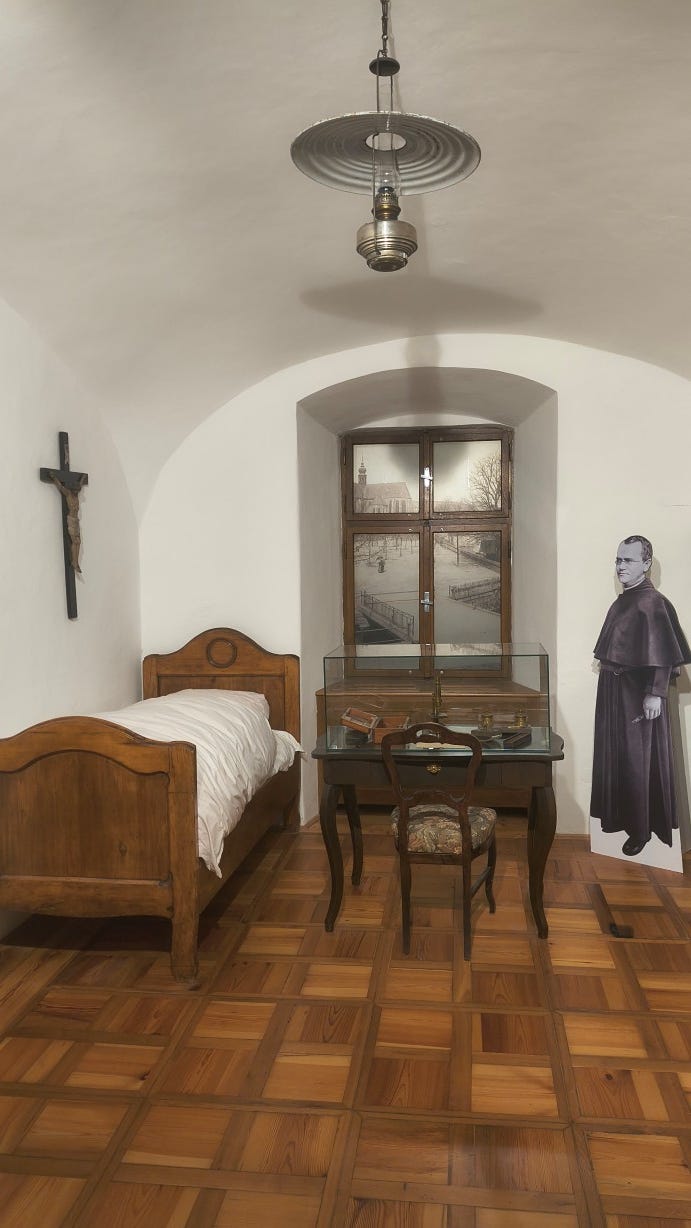
I had the great privilege last month of attending a Workshop, Genomics meets Exposomics, at the Mendel Museum in Brno, Czechia. It was awesome, not just because the scientific discussions were top-level, but because meeting literally downstairs from the dormitory room where the good abbot Gregor lived and surveyed his pea garden for much of the period during which he discovered the laws of inheritance, was awe-inspiring.
The theme of the meeting was advancing gene-by-environment studies, namely planning for a scientific enterprise in which studies of the exposome not only match those of the genome but are integrated with them. Readers of this Substack are undoubtedly well-aware of how much GWAS has taught us about genetic architecture over the past two decades. And also that genetics is only part of the equation, the majority part being the ‘environment’. We’ve become adept at reading the G for Genetics in heritability = G/(G+E) and recognize that it is well past time that we get more sophisticated about reading the E. Surely we can do better than recognizing that this person survives on low income, that one consumes too much wine, and the one over there spends far too much time watching MSNBC.
E for Environment is a catch-all that includes all manner of contexts: familial, social, physical, biological; random and mismeasured. E for exposome is more restricted, basically measurable chemicals; perhaps including anthropometry and validated survey items. The strongest molecular exposure affecting my life currently is the neuronal firing responsible for the thoughts of a small band of powerful men attempting to reshape American science and society. Actually, maybe it is AI, but that’s another story. Deep profiling of synapses and chemicals in certain nuclei of my own brain might uncover changes this stress has induced that are unlike those of any other 10- month period in my adult life. Alas, it is unlikely that any level of exposomics would reveal the distal culprits. Measurement only gets you so far.
Yet so far might well be a long way, as outlined in this important perspective from Gary Miller and others a few years ago. Certainly, high resolution mass spectrometry (HRMS) generates a lot of data: tens of thousands of points captured from millions of people would be GWAS scale. Do we contrive new cohorts, add on to existing ones (yes!), or just wait 10 years for Google and Apple to gather the data for us, from millions of users who will surely think it is a good idea to capture their external environment with wearable devices and share the information over the internet? The latter would be a biased cohort, but presumably more inclusive of diverse lives than sampling the types of affluent urbanites who tend to interact with academic medical centers. But we’re not just interested in the pollution and microplastics and molds and pesticides and so forth that our bodies absorb. Bodily fluids include metabolites and microbial products and drugs and processed food items that are at least as relevant to a person’s health. While they might not tell us what is happening in the vicinity of the beta islet cells of a diabetic’s pancreas or the prefrontal cortex of an adolescent boy, they’re surely at least as informative as the complete blood count that doctors currently order routinely. All of this, as well as heat, noise, sleep, and exercise, are measurable and collectively as important as genetics for public health, so what are we waiting for?
My session of the meeting was concerned with how to integrate genomic analysis with exposome data. Andrea Ganna talked about how fitting the genotypes that influence metabolite levels into regression models improves predictive accuracy – bravely, given where we were, someone referred to this as de-Mendelizing the exposome. Shamil Sunyaev talked about the promise of HRMS plus whole genome sequencing to resolve the proximate causes of rare metabolic disorders. I gave my ten minutes to stressing how polygenic scores only make sense in the context of relevant exposures, and that interactions between the two are crucial. The bigger point though is that so much more will be learned by the pairing of genomic and exposomic technologies than by each one going it alone.
I sometimes wonder what our conception of heritability would look like if we approached the equation from the E-side: instead of teaching the equation above, we taught that (1- h2) = E/(G+E) and implored researchers to go out and measure as many components of E as they can and then estimate how much of the phenotypic variance is explained. If the two E and G-based estimates failed to sum to anywhere near 1, would we conclude that there is missing genetic or environmental variance? If they summed to more than 1, might we conclude that the genetic component has been overestimated? With population-scale exposomics on the horizon, we may find out – so long as we are confident in our G-based estimates.
It is fitting then that also this month, Loic Yengo and colleagues have a preprint at Nature (Wainschtein et al, 2025) arguing that the so-called “missing heritability gap” has closed sufficiently enough to call it essentially bridged. This is the difference between classical estimates of heritability in pedigrees and SNP-based estimates in outbred populations from methods such as GREML (genome-based restricted maximum likelihood). When I wrote the “hints of hidden heritability” perspective to accompany Jian Yang et al’s initial publication of this approach in Nature Genetics back in 2010, I put myself firmly in the camp of those who considered that most of the heritability would eventually be found to be simply hidden, not missing. Phew (though I also stated that I doubted all the heritability for a trait like height would ever be discovered – oops).
By analogy, missing is what happens when you drop your phone overboard and it sinks to the bottom of the ocean, likely never to be found, whereas hidden is when it is obscured by all the papers on your desk and you just need to look harder. The assumption that heritability was missing probably derived from a willful desire for effect sizes to be larger than they are; once the infinitesimal model is embraced, the hidden heritability proposition becomes more attractive. The new study looks harder in two ways: it considers almost 350,000 people in the UK Biobank instead of 3,500 Brisbaners; and it uses whole genome sequencing to precisely capture rare as well as common variants. Intriguingly, Yang et al predicted this outcome in their 2010 paper after adjusting for the expectation that larger effects would be selected against and hence rarer and unobservable at the time. What they now show is that pedigree-based heritability across 34 traits averages .32, which is just 12% more than the 0.28 they now obtain with GREML. For more than half the traits, the estimates are not statistically different. Gap closed.
I will assign this paper for the final exam in my Human Genetics class next week and have encouraged the students to use Notebook-LM to help them understand the concepts. Notebook-LM is a quite remarkable Google-AI service that not only summarizes the paper, but in just a few minutes generates a multiple-choice quiz (with explained answers), a map of the paper, a 15-minute incredibly realistic podcast, and a 10-minute cartoon video. Of course it is overwhelmingly positive and uncritical; yet it does provide useful insights and analogies. These are juxtaposed with non-sequiturs like “rare variants are those with a minor allele frequency less than 1%, namely seen in 1 in 100 people or fewer” (carriers are actually twice as common). The dialog seems like it is between two media-savvy experts. Interestingly it can also be bet-hedging: the podcast for example told me how incredible and fundamental it is that there is a 36-fold enrichment in heritability explained by common coding variants relative to their prevalence, whereas the video lamented that the coding variants only explain 17% of the heritability, a remarkably small proportion!
More engaged students will have visited Sasha Gusev’s Infinitesimal Substack where they will find a nuanced and critical appraisal putting the study in context of other recent (and ancient) heritability estimates. He includes a chart showing that the GREML estimates are much the same as those of two other regression methods explicitly designed to quantify the narrow-sense (additive) heritability, namely ~30% on average, but 25% smaller than corresponding kinship-based estimates (~40% on average) for 14 traits in common. This is a considerably larger gap than Wainschtein report for the 34 traits and I’m not sure what to make of it. However, Sasha’s point that classical twin studies generate estimates more like 60% underscores the conclusion that those tend to overestimate the genetic contribution, due to indirect effects. That source of the gap seems to have been artificial.
It is also worth pointing out that GREML has its critics. The method is basically a regression of pairwise genetic similarity on phenotypic similarity. The latter may be biased by scaling or mismeasurement, and the former has the non-intuitive property that it is dependent on the study population. If we compute the genetic similarity between two people, the estimate turns out to be slightly different if they are measured in Boston or Atlanta or Sydney or Barcelona. One reason is because the similarity equation includes the frequency of each reference allele; another is because there are inevitably hidden confounders affecting the sample, such as assortative mating or local population structure. Wainschtein et al are well-aware of this and a nice aspect of their study imo is how they control for these and show convergence of estimates when they do so. Their conclusion that the missing heritability was mostly hidden is ultimately very convincing.
There are some other nice aspects. One is an estimate of the relative contributions of rare (MAF between 0.0001 and 0.01) and common (MAF greater than 0.01) variants, the former accounting for ~20% of the heritability (much more than this for one notable trait) which is more than I’d have expected and a major reason for the gap closure. Another is the inference that rare effects are clustered in the vicinity of common ones, further illustrating how genetic effects are not actually present throughout the genome: “only” perhaps a fifth of all loci contribute to any given quantitative trait. I’m not surprised that most of the heritability maps to non-coding DNA, and glad to see this is as true of rare as common effects. Some of the subtle trait differences also point to possible cases where non-additive effects still matter.
Speaking of which, as someone trained in fly genetics and used to seeing epistasis and genotype-by-environment interactions whenever crosses are set up, it still pains me to conclude that additive effects explain the vast majority of the heritability. So it is important to emphasize that these results do not mean that interaction effects can be ignored. It is just that they wash out in large populations. Remember that heritability is the proportion of the variance explained in a population; if you reduce the population to a family or ultimately an individual, interactions can still be critical. A virus contracted as an infant, a bike accident as a teenager, might well be the deciding factors in whether or not one twin becomes autoimmune or suffers from a neurological disorder. Genetic backgrounds can and do modify the penetrance and expressivity of rare mutations as well. Such interactions do not appear as major contributors to the overall variance and do not appear in GREML or standard GWAS, but they are the stuff of personalized medicine.
Which finally brings us to the title of this Take, “Exposing and Finding the Heritability.” What I am excited about with exposomics is the potential to illuminate still-hidden secrets of genetic susceptibility. Whether it is environmental modulation of polygenic risk in small communities, or bespoke interaction measures explaining why two people with equivalent genetic risk have dissimilar outcomes, exposure measurement at scale might well be a bridge between heritability and inheritance.
Coda: Heartfelt gratitude to the organizers of the Brno workshop, especially Gary Miller and Sophie Thuault-Restituito (Columbia), Chirag Patel (Harvard) and Jana Klánová (Masaryk University). Děkuji od dalšího Gregora.

Thanks for the comment, Sasha. I reached out to Loic and Peter V and they both confirmed that the actual modelling of h2_PED makes quite a difference to the amount of variance explained, notably the quadratic term capturing either epistatic or G-E correlations. This is clearly stated in the paper. So while the heritability gap has closed, the broad sense contribution remains contentious - next step multi-million sibpair studies.
Nice discussion, I'm now really missing not being able to attend the workshop. Regarding the kinship estimates, the main discrepancy is Wainschtein et al. use several different kinship models. When h2_PED is estimated using a purely additive model, the h2_WGS is 65% of the h2_PED on average (what I reported); when h2_PED is estimated using the additive term from a model that also includes an epistatic term, the h2_WGS is 84% of the h2_PED (closer to what Wainschtein et al. reported with the remaining difference due to traits that have no twin study estimates). The fact that some of the additive h2_PED is potentially explained by an epistatic component is either evidence of a bit of genuine non-additive epistasis or (my hunch) non-linear environmental sharing between close relatives. So don't count interactions entirely out just yet.