
Heritability, Fluidity, and Morality
113th Take

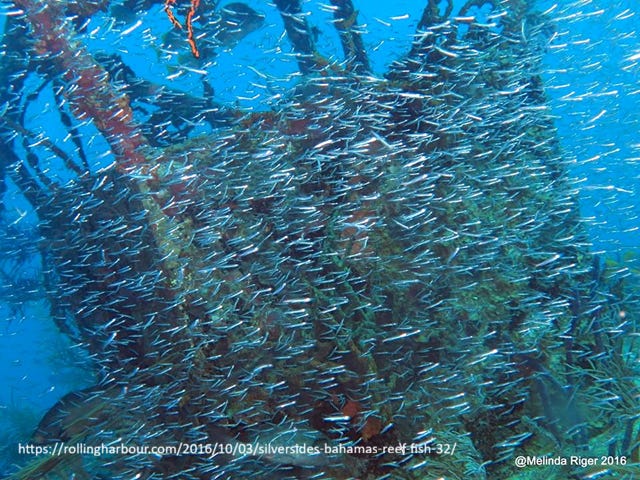
Several of my most amazing experiences have come while scuba diving: floating meters away from majestic manta rays off the coast of Bali, swimming through shoals of synchronized silverside fish in the Bahamas. They are so quick, so effortless in their collective behavior presenting as a shimmering silver screen of coordinated movement, impervious to any perturbation. Everyone should have the opportunity to experience such joys.
I was reminded of this last week when David Brooks posted an opinion piece entitled “What are We Thinking” in the New York Times, accompanied by a video loop of a flock of murmuring starlings. The piece starts by considering the shift in neuroscience from delineating modules of activity to investigating how the activities of modules are coordinated. The starlings are a metaphor for orchestrated ensembles: “No single starling organizes this ballet (of swooping and swirling), yet out of the local interactions between all the starlings a coordinated dance emerges.” Brooks goes on to pose a thought experiment: what if teachers regarded their students as individual flocks of starlings rather than a room full of computers waiting to be filled with data and algorithms?
He imagines three consequences. First you would have a much richer perception of individuality, forcing us into the realization that measuring achievement along singular axes where each person is defined in relation to the mean is, well, demeaning. Second you would see that when we consider trajectories rather than cross-sections, that temperament is contextual. Human personalities should not be defined by their average attributes but rather by their spectrum of responses to the situations that life throws at us. Third you would open your mind to the interconnectedness of all of those defining attributes, to the reality that conscientiousness and irritability and empathy may well be measurable entities, but it is their dance with one another, their fluidity, that makes a person.
In summary, “reason, emotions and desires are just different resources people draw upon to help make judgments about what to do next. Each faculty has its own strengths and weaknesses, and life goes best when a person coordinates all the faculties in one graceful swirl.”
I am wondering today whether it is time for geneticists to move on from the dissection of static traits to a full embrace of the complexity of fluidity.
We can start with the contention that genome-wide association studies are intrinsically modular. They start with a trait that, whether categorical or continuous, is almost always conceived as a constant state. Even multivariate models that take several measurements over time and reduce this variation to a singular average value; or if it is a diagnosis of disease, the target of analysis is that singular state. (Despite the fact that emerging evidence implies that the genetics of disease susceptibility is in general quite different from that of disease survival.) Then a polygenic score derived from the GWAS entrenches this singularity in a grand measure of where each person stands relative to the population mean, from whence risk is evaluated and imperfectly personalized.
You could further argue that this perspective is even more deeply entrenched in the way that heritability is partitioned. Classically, we imagine two sources of variance and define heritability as the proportion of the variance in a population that is due to genotypic variance, G. All else is collapsed into environmental variance, E. How different might those heritability measures be if instead of h2 = G / (G + E), when considering longitudinal data we conceptualized the relationship as G / (G + F + E) where F stands for a measure of an individual’s fluidity and is assumed itself to be subject to genetic variance that may or may not be orthogonal to the main component of G.
The closest we get to this, I believe, is random regression modeling of longitudinal data in livestock, which I only just became aware of while writing this Take. There is also perhaps similarity in variance QTL modeling, which seeks to identify genetic variants that are associated with the variability of the trait. A vQTL exists where the variability of one homozygote class is less than that of the heterozygotes and in turn the other homozygote class. But this type of analysis is usually performed across individuals, whereas what is relevant to fluidity is within individuals. Are there variants that associate with how much the trait varies within a person, and are they independent of those that associate with the trait itself? Is it the case that some people are much more fluid for a given trait than others due to their genetic predisposition?
An obvious place to consider this problem is in relation to frailty, defined in a recent GWAS by Isabelle Foote, Andrew Grotzinger and colleagues from the University of Colorado as “a multifaceted clinical state associated with accelerated aging and adverse health outcomes.” Rather than aggregating 30 contributing deficits into a single frailty index, their fascinating path analysis leads to the identification of seven somewhat independent latent genetic components of frailty. A general frailty factor relates most strongly to half of the measures that range from pain to loneliness, while six others capture susceptibility in domains of social support, unhealthy lifestyle, metabolic and cognitive dysfunction, longstanding disability, and multimorbidity. The approach identifies many more SNP associations (408 in all so far) and leads to PGS that show potential for stratifying individual risk for such personalized aspects of health decline as dementia, cardiovascular disease, and weakened immunity.
Yet while frailty is quintessentially a fluid trait, namely the transition from a state of generally good health to one of chronic morbidity, this approach does not really embrace fluidity. We all know elderly folks whose walking pace slowed early, others who have always struggled to recover from seasonal infections, or perhaps must fight mental health demons, and likely we hope to count ourselves among those who will be active and aware well into our nineties. Some might wish to know their liabilities in these domains from an early age, and this work is a definite step in that direction, though it would be a mistake to put too much store in the scores. More to my point, if we embrace fluidity, what is needed next is an understanding of how the genetics of frailty interacts with the passage of life. Geroscience aims to intervene physiologically and behaviorally to slow decline, and surely if it is to incorporate polygenic risk it needs to do so in the full wisdom of contextual dependency.
Another domain where consideration of fluidity may well be informative is moral persona. This is particularly apt right now as we witness the unravelling of long-held norms of social and political behavior in the US and elsewhere: what Canadian Prime Minister Mark Carney recently labeled the rupture in the world order. Noone knows whether it is a temporary blip driven by the enduring popularity of one mentally ill but extraordinarily powerful and simultaneously frail old man, or whether it represents a step toward semi-permanency orchestrated by zealots using that man to their ends while scheming behind the scenes for succession. No matter your political leaning, what is clear is that this is not normal. It also raises the question of what genetics has to do with it, if anything at all.
As with any genetic enquiry, the baseline given is that we must expect diversity. Psychologists recognize that people are endowed with temperaments that they shape into personalities as they move through life, using free will and self-determination to mold their character. That they do so adjusting for circumstance and norms, presumably attempting to maximize their own happiness, tells us to expect that heritability of personality will be lower than that of temperament. I suspect that a poll of readers regarding their guess at what proportion of the variance in temperament is genetic would generally return answers between 10% and 60%. My own inclination is toward the middle of the range, but admittedly somewhat meaningless with regard to my main thesis. More interesting is what happens if we include fluidity in the calculation. If we ask what proportion of a particular temperament in a given context is genetic, the answer is almost certainly higher. And if we allow for fluidity in the partitioning, we should expect to uncover a genetic component concerning the variability of that temperament across contexts. There will be people who adapt readily to circumstance, or whose character is remarkably constant, or who find themselves unduly influenced by influencers. Clearly, people are not silversides or starlings, many of us elect to swim counter to the norm.
This insight then impinges on how we think about virtue. Dictionary definitions of virtue are of little help: “behavior showing high moral standards” allows domineering dictators, benign Buddhist monks, and passionate pluralists to equally claim high virtue. Given the existence of variance, the dictator may argue, we should expect there to be individuals who will seek command and think nothing of controlling others. Yet the fact that history is accomplished by doers does not mean, the pluralist responds, that autocracy is the path most inclined to maximizing utility. History also tells us that the changes wrought by dictators tend to be undone within a generation if not decade of their demise, that societies inevitably trend back to norms shaped by the averaging of human character. The grand liberal democratic project over the past century has been about building pluralism into political structures in the conviction that this is best for society.
Accordingly, Aristotelian virtue is about finding the golden mean between excess and deficiency, pursuing practical wisdom, and valuing perspicacity. It is about constant reevaluation of one’s decisions in light of their impact on others, listening to many voices when evaluating expected short and long-term consequences, allowing for fluidity.
Only through this lens can I make sense of the actions of ICE agents. We know from Stanley Milgram’s psychology experiments conducted in the early 1960s that two thirds of people are willing to deliver lethal electric shocks when told to do so. It is only through this lens that I can understand how an agent can shoot a prone nurse in the back multiple times. It is only through this lens that I can understand how a human can dine in a Mexican restaurant and then go out back and arrest the people who had just fed him. It is only through this lens that I can understand how someone otherwise decent can detain a two-year-old’s parents and leave the child alone in the street in a state of terror, and even worse to use them as bait to lure other immigrants. Although the job selects for authoritarian temperaments, I have to believe that few of the men would perform such acts without incitement, and that some number are as appalled as the rest of us at what their colleagues are doing. Recognizing that there is a genetic component to fluidity does not of course excuse immoral behavior.
So, should someone perform a GWAS for moral fluidity? Maybe, but it would be highly unlikely to tell us anything we cannot already intuit; more likely to distract our attention from the reality that the solutions are political not biological. America, I suspect, is more at risk for falling prey to autocracy than other Western democracies. We have electorates that for the most part guarantee single party representation, whether by gerrymandering or natural social assortment. We have primaries that favor nomination of partisans likely to adopt extreme positions rather than seek commonality. We have majoritarian rather than proportional representation that mitigates against compromise. We have a two-party system that favors combative debate over pluralist cooperation. And currently we have an empowered executive unconstrained by the legislative and judicial arms. And yet that system has worked rather well for the better part of 80 years, which reinforces the contextuality of current ‘leadership’.
Perhaps then we are just experiencing the fourth turning according to Strauss-Howe generational theory. If so, we can only hope that it takes less than a world war or civil war to push us over the hump, back to social norms that are respectful of the diversity of moral personality, to a world of value-based realism. When all this is over perhaps the political scientists can help stitch together policies and structures that more robustly favor pluralism, founded in virtue ethics, itself consistent with contemporary understanding of genetics.
@Ujjaini Many thanks for your comment. I am sure there is lots to be done in this space, hopefully you have the opportunity.
I think Ujjaini’s comment on fluidity as “signal rather than noise” captures beautifully the core idea. It also brought to mind Waddington’s notion of homeorhesis. I have the feeling that thinking in terms of stability of trajectories (rather than stability of states) will gradually gain more presence in the field...