
Virtuous Genetics
One hundred and fourth Take.

A small boy chases his ball as it rolls under a blackbrush shrub in the corner of the park. Since the sun is not yet high and baking, the dew glistening on a spider’s web attracts his attention briefly, but it is shortly darkened by the shadow of a tall man. The initials I.C.E. across the back of his royal blue jacket make little sense at this hour. Drawn to the man by curiosity, the boy is quickly brushed aside as instead he watches his mother seized and marched to a waiting van, hands cuffed behind her back. The boy’s wails dissipate into the chatter of the cactus wrens.
A few days later he sits subdued with a handful of other children in the anteroom of a women’s shelter now located across the street from a hastily constructed detention center. The director quickly slams the door shut as the I.C.E. man looms at the entrance, demanding that she move aside to give him access to the illegals inside. She asks, what sort of monster separates children from their mothers for a living? He bellows, I was in New York the day the twin towers fell and vowed then to devote my life to protecting this country from all foreign adversaries. The real question is what sort of citizen willfully resists the demands of her government? She spits back, I too was in Manhattan that day and lost my best friend in the attack, ultimately seeing her daughter placed in foster care. I committed my life to helping mothers and children stay together, so the only way you get in there is after arresting me.
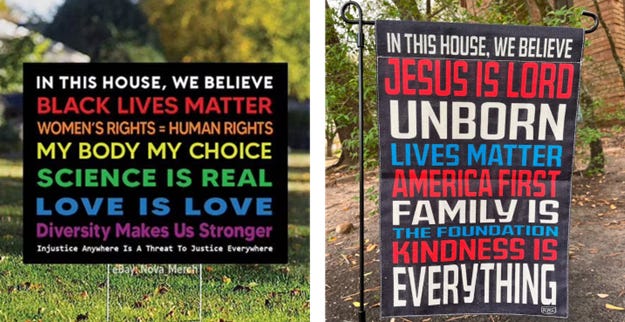
How is it possible that two passionate people can reach such incompatible views as to what constitutes moral behavior? How is it that in contemporary America whole communities exist just miles apart whose guiding principles are as divergent as those enunciated in their yard signs pictured above? The argument I will briefly develop here is that it has just enough to do with genetics for us to be grateful for genetic diversity. And further that the solution to a more harmonious society lies, as a consequence, in a recommitment to virtue ethics.
Before you shudder at the insinuation of genetic determinism, let’s start by dispensing with the idea that a person’s genome sequence somehow provides a blueprint for who they will become as a moral individual. Genes no more determine that one person will become an agent of law enforcement willing to forcibly separate families, than they ensure that another person will one day voluntarily drag their child away from family and community across a desert to enter another country illegally. What our genome does ensure though is that there will be variation across all people in what they value most deeply and how they respond to events in the world around them.
The metaphor I like to use to describe the influence of genetic variation is that of the influence of tides upon the waves. If you stand on a beach and look a hundred feet out to sea at the white crests forming as each wave starts to rise, there is absolutely no way you can know whether eventually that wave will push water up to your feet or whether it will trickle out well behind the preceding one. Perhaps if you stare intently enough for fifteen minutes, counting the advances of hundreds of waves, you might get a sense of whether the tide is ebbing or flooding. Surely if you stand there for an entire day you will experience the power of the tides, spending some of the time watching them lap the dunes and others marveling as you walk or play on the expansive sand. In retrospect you may say that the path taken by this wave or that was in some sense caused by the tide since the likelihood of peaking at your feet shifts with the tide, but prospectively you cannot know the fate of any individual wave.
Currently there are two books about genetics and behavior circulating, both titled “Blueprint”. The one by psychologist Robert Plomin, subtitled “how DNA makes us who we are”, takes a decidedly more deterministic position than is plausible, mistaking partial explanation for prediction. The other one, by social network anthropologist Nicholas Christakis, subtitled “the evolutionary origins of a good society”, lays out an argument for the average group behavior being grounded in what he calls the evolved “social suite” of love, friendship and cooperation. What quantitative geneticists are concerned with, though, is the variance about the mean. The problem with the idea of a blueprint is that it implies a correspondence between the instructions and the outcome that is simply unrealistic when it comes to biology. Rather, genomes provide a framework, a concept of a plan, if you like. Within that framework, diversity is guaranteed by some combination of genetic variation, environmental influence, chance, and the malleability of human free will.
In Book II of the Nichomachian Ethics, as Aristotle seeks to define Moral Virtue, he asks us to contrast passions, capacities, and states of character as three aspects of the soul. By passions he means feelings that may be accompanied by pain or pleasure, such as anger, hatred, joy or friendliness. He recognizes that we each experience different natural capacities to feel such passions, but since “neither by nature nor contrary to nature do the virtues arise in us; rather we are adapted by nature to receive them,” character refers to how we actually express our passions under the influence of contemplation. Virtuous character expresses temperance, courage, justice and practical wisdom, tending toward the golden mean. Stated another way, we each have innate tendencies to experience moral passions, but our moral character is defined by the choices we freely make, by how we modulate those tendencies as a member of a society whose norms are shaped by the average capacities.
What does genetics have to do with these differences in capacity? Once again, it is critical not to equate innate with genetic: the impulse to do so arises from the false dichotomy of nature and nurture. If nature gives us a baby and nurture is all that follows, it is too easy to assume that genetics is responsible for the innate. The appropriate interpretation is that genetic variation contributes to the innate, and subsequently nurtured, variation in temperament seen across all people, without any claim that it is the reason why you or I are specifically the way we are. We are also free agents not just capable of change as we age, but responsible for how we do so.
What then is the nature of the genetic variation that distinguishes the liberal and conservative mindsets? There must be dozens of ways to contemplate this, but I think a good place to start is Jonathan Haidt’s “righteousness” axis. His research on moral foundations theory reveals that self-described liberals tend to give higher valence to passions related to empathy and justice, whereas conservatives are more likely to embrace authority and loyalty and something called sanctity. That is not to say that our I.C.E. agent is indifferent to the rights of those he detains, nor that our social worker does not believe in rules and regulations. In a healthy society as in a happy person, the passions are not so much competing as complementing. Hence virtue is found not in everyone sharing the same morals so much as in a commitment to respecting differences of opinion. Decency is found in the willingness to moderate our own passions, expecting others to reciprocate.
This view of genetics and morality, that genetic diversity guarantees diversity of capacity for all those passions that the yard signs highlight, has two deep consequences. The first is that it provides a philosophical basis for the claim that virtue is to be found in the middle. Humans collectively benefit from the multitude of personality types our genome supports: explorers, leaders, critics, influencers and followers. Virtue does not demand that everyone thinks or even feels alike, but it does ask for acknowledgement that our own firmly held positions are always going to be in conflict with others’ positions. Compromise does not mean giving up or accepting a bland average, it means pluralistic give and take, which itself can be contemporaneous and/or cyclical. One tribe may dominate for a time, but the belief that it is possible and desirable to reprogram the moral sensibilities of millions of people is pure folly.
The second is that it provides a reasonable expectation that the pendulum will swing back. It is astonishing how quickly public discourse has flipped in the past few weeks in America. Most of us in academia are numbed not just by the specter of funding cuts, but also the sense that there are now thought police scouring our grant proposals and papers for banned words like climate change, female, inequality, and socioeconomic that a month ago were legitimate – if not essential - subjects of our curiosity. Millions are feeling the effects more directly with their jobs, pocketbooks and sense of belonging. Of course, those driving the change would argue they are just nudging the pendulum back to its more natural center. Such a claim would be more believable if instead of using the wrecking ball of acerbic cultural warfare, they sat down with the mainstream silent majority, scalpel in hand to remove the perceived tumors. Instead, it sure feels like we are experiencing a king-tide of conservative moral fervor. Authoritarians have the advantage that their ethical foundation is deontological certitude.
No-one can know whether America’s recent descent into Russian-style oligarchy is semi-permanent, but history suggests that is unlikely. Whether it takes 2 years, 4 years, 8 years, or more, our genetics is not changing. It provides an antidote to demagoguery founded on the belief that moral capacities can be culturally engineered. Once the fervor ebbs, we can get back to dialogue and understanding. In the meantime, we can hope for more virtue in all spheres of life: parents calling out their teenagers for hateful social media posts, politicians self-reflecting before pointing the finger of hypocrisy, all of us doing what we can to slow the spread of misinformation. Rebuff vanity, anger and shaming with magnanimity, patience and modesty; repel extremism with decency.